As your Employer of Record, Africa Deployments sponsors your expats’ work permits and visas across Africa, with our own registered entities in Mauritius, Morocco, Kenya and South Africa.

We prepare, file and track each expat's permit under the country's own immigration and labour laws.
Africa Deployments acts as your Employer of Record and sponsor, so you deploy expats without a local company.
We pick the fastest legal route per country, such as Morocco's intra-company route or Kenya's Special Pass.
Certified, translated and legalised qualifications, contracts and company documents, ready for each authority's checklist.
Visa and residence support for the spouses and children joining your expats.
Residence cards and foreign national registrations filed on time, such as Morocco's 90-day residence card deadline.
Navigate local immigration portals, labor office quotas, and visa regulations with our team of in-country experts.
One team runs each expat from the first filing to permit renewal and offboarding.
Bridge routes get expats working sooner: a Kenyan Special Pass or Morocco's intra-company route can take 2 to 3 weeks.
Employment contracts built to each country's foreign employee rules, from Morocco's Ministry model to Kenya's understudy plan.
We hold every expat start date until the permit or pass is issued. Starting early breaks immigration law across our entity countries.
Combine work permit sponsorship with our Global Mobility Africa service for assignments, payroll and tax residence.
Sponsoring one specialist or a full project workforce? Africa Deployments also covers the Employer of Record, payroll and mobility work that follows every approved permit.
Sponsor through Africa Deployments and skip company formation, local tax registration and branch administration in each country.
One documented process for every expat file, whatever the country.
A dedicated account manager follows each expat file from the first document check to approval.
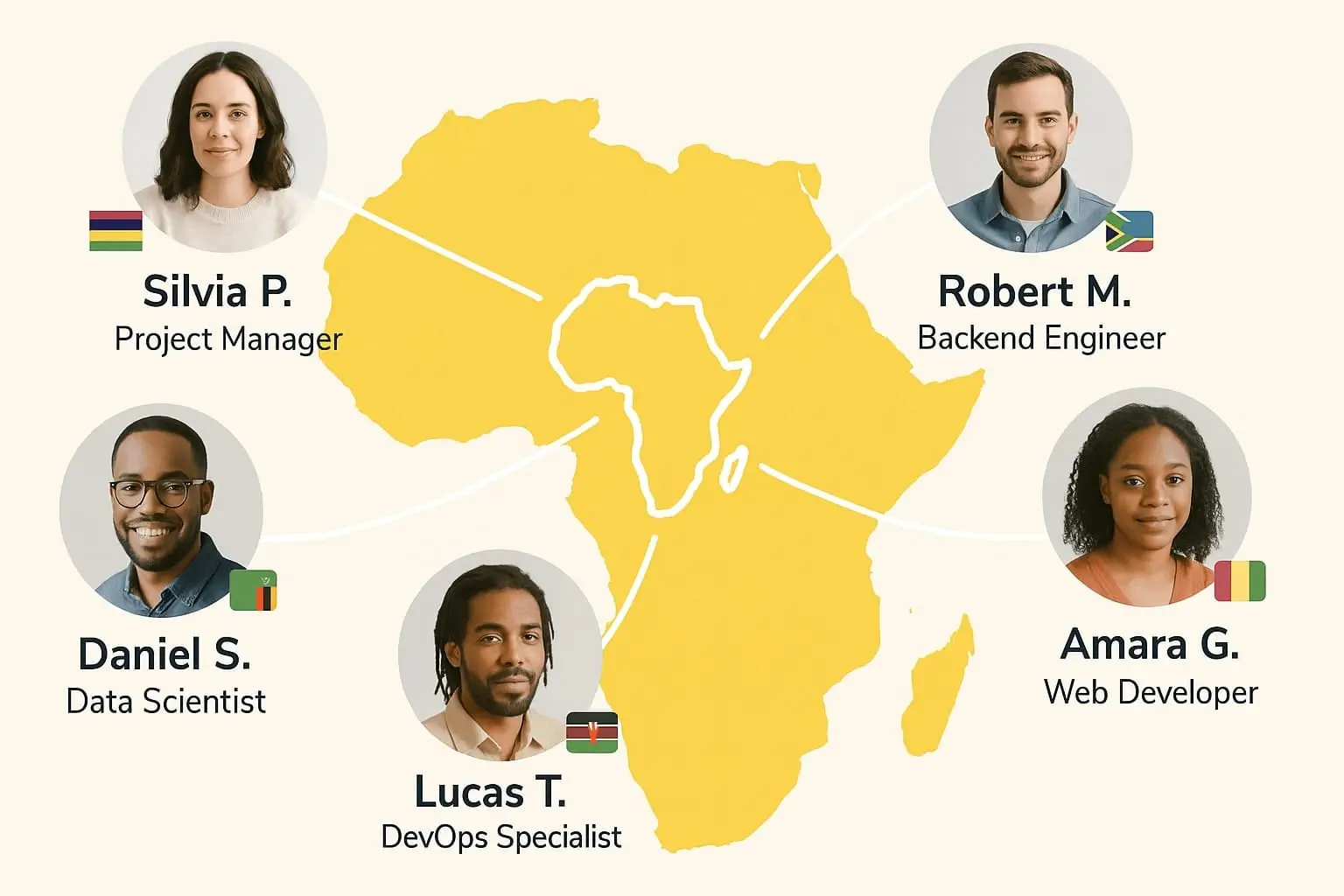
Sponsor and deploy expat specialists across 54 African countries through one Employer of Record.
Manage every expat's permit, visa and residence files through one contact, across every country.
Scale from a single expat to a 100+ person workforce deployment without managing multiple subsidiaries.
Chief Human Resources Officer,
GetMyBoat
“Working with Africa Deployments allowed us to quickly hire top talent across East Africa without establishing separate entities. Their service is absolutely invaluable.”
Chief Operations Officer EMEA,
Global Finance Partners
Head of Legal,
Ergos Mining
Each African country issues its own work permit under its own immigration and labour laws. The names differ: Morocco stamps a visa on the employment contract, Kenya issues a Class D permit, Mauritius an Occupation Permit and South Africa a Critical Skills or ICT work visa.
No. Each country issues its own. The African Union’s 2018 Free Movement of Persons Protocol needs 15 ratifications to take effect, and only 4 member states had ratified by July 2025 (Ghana News Agency, 2025).
Yes, where the EOR acts as the local employer. Africa Deployments sponsors expats through our own registered entities in Mauritius, Morocco, Kenya and South Africa, and supports work permit sponsorship across 54 African countries.
All 54 African countries. In Mauritius, Morocco, Kenya and South Africa, we sponsor through our own registered entities, and local employees there can be onboarded in as little as 48 hours.
It varies by country. Kenyan Class D permits take about 2 to 3 months, Mauritius Occupation Permits about 2 months, Morocco’s standard route about 2 to 3 months, and South African missions outside Africa typically finalise work visas within 90 days.
Some do. Kenya issues a Special Pass for up to 6 months, usually in 2 to 3 weeks, and South Africa’s Section 11(2) visa authorises work for up to 6 months. In Morocco, our intra-company route cuts the wait to 2 to 3 weeks.
Visits are easy, work is not. US citizens enter Morocco and South Africa visa-free for up to 90 days, Mauritius on arrival, and Kenya with an eTA. None of those entries allow paid work, so a work permit comes first.
Expect a valid passport, photos, certified and legalised qualifications with translations, a CV, the employment contract, and the employer’s registration and tax documents. Several countries also ask for a police clearance and a medical certificate.
Many do. Morocco’s ANAPEC certificate, Kenya’s proof that the role could not be filled locally and South Africa’s labour certificate for General Work Visas all check that no qualified local worker is available. Intra-company and critical skills routes often skip the test.
Some countries want expats to pass on their skills. Kenya’s Class D permit names a Kenyan understudy for the role, and South Africa’s Intra-Company Transfer visa needs a skills transfer plan for a local trainee.
No. Across our entity countries, payroll and work wait for the permit or pass. Where speed matters, a bridge such as Kenya’s Special Pass or South Africa’s Section 11(2) visa covers the gap.
Not for local employment. Kenya’s Class N Digital Nomad permit, South Africa’s Remote Work Visa and Mauritius’s Premium Visa all exclude work for a local employer, including through an Employer of Record.
Government fees vary widely. Kenya charges KES 20,000 to process a Class D permit plus KES 500,000 a year on issuance (Directorate of Immigration Services, 2025), while South Africa’s embassy in the US charges USD 127 for a work visa.
Usually, yes. Kenya’s dependant pass costs KES 10,000 for work permit holders, South African family visas run for the same term as the expat’s, and Mauritius grants residence permits to dependants of Occupation Permit holders.
It depends on the permit. Kenyan Class D permits are currently issued for up to 2 years, South African Critical Skills visas for up to 5 and ICT visas for up to 4, and Moroccan long-term work visas for 1 year, renewable.
It depends on the permit. Kenyan Class D permits are currently issued for up to 2 years, South African Critical Skills visas for up to 5 and ICT visas for up to 4, and Moroccan long-term work visas for 1 year, renewable.
It depends on the permit. Kenyan Class D permits are currently issued for up to 2 years, South African Critical Skills visas for up to 5 and ICT visas for up to 4, and Moroccan long-term work visas for 1 year, renewable.
Usually not. In Morocco, Kenya and Mauritius, the permit ties to one employer and one approved contract, so a new employer files a new application.
Sometimes. Morocco requires a residence card within 90 days of arrival, Kenya registers stays beyond 90 days for an alien card, while Mauritius’s Occupation Permit already includes residence.
It depends. Mauritius needs the expat in-country for the medical, the morality certificate and EDB biometrics, while South African and Moroccan work visas are lodged at consulates abroad.
Not on your own, because a local employer must sponsor the application. Africa Deployments becomes that employer as your Employer of Record, so you deploy expats without opening a branch.
Start early. We recommend at least 3 months ahead in Kenya and at least 2 months ahead in Mauritius, and every renewal needs fresh documents such as tax compliance certificates or updated contracts.
It is closed out. In Kenya, the permit is cancelled within about 14 days, and employers must tell Immigration within 15 days when a permit holder stops working. We handle these steps in every country.
Share the countries, the expat’s nationality, role, qualifications and target start date. We confirm the fastest legal route per country, send the document checklist and open the file once the originals arrive.